October 22, 2026
Year-End Distributions and Tax Timing for Income ETFs
Some income ETFs pay their largest distributions of the year in late December. How ex-dates, return of capital and the January rule shape your 2026 tax bill.
Related profiles: QDTE , XDTE , DIVO , SPYI , QQQI , JEPI , QYLD

Most income ETFs pay on a steady rhythm all year. A handful break pattern in December, either by adding a capital gains distribution to the regular payout or by paying several times their usual amount in the last two weeks of the year.
If you hold these funds in an IRA or 401(k), none of that changes your tax bill. In a taxable brokerage account, the year’s tax picture is mostly set by December 31, and it turns on three things: when you buy relative to the ex-date, which year a payout counts in, and how the fund classifies what it paid you. Most of the rules below come straight from IRS Publication 550.
What a big December payout looks like
The examples below are from December 2025, the most recent year-end in our data, and show what to watch for this December. The clearest one is QDTE, the Roundhill Nasdaq-100 0DTE covered call fund. It pays weekly, and for most of the fall of 2025 the payment sat around $0.20 to $0.23 per share. Then two payments in a row came in far higher.
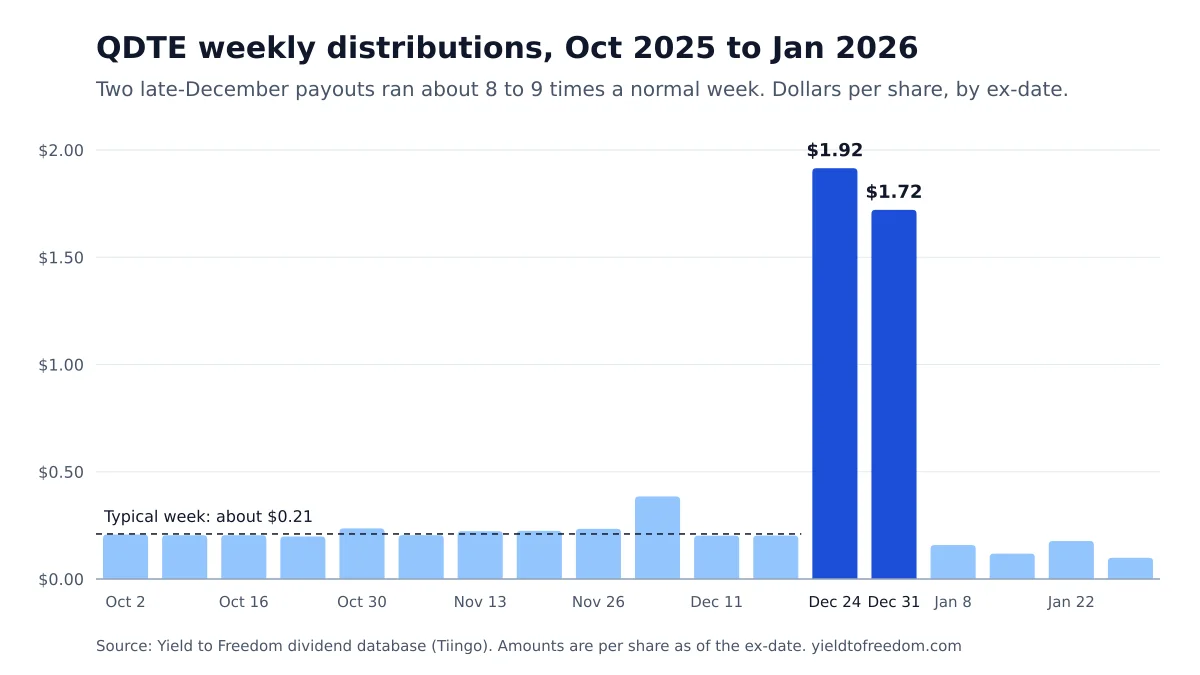
| 2025 ex-date | Payout | Prior close | Ex-date close |
|---|---|---|---|
| Dec 24 | $1.9151 | $34.78 | $32.96 |
| Dec 31 | $1.7210 | $32.82 | $30.84 |
On each ex-date the share price fell by close to the amount of the payout. The cash leaves the fund when it is paid out, so net asset value drops by the same amount. Ordinary market moves are mixed in, which is why the December 31 drop was a little larger than the payment.
Someone who bought 100 shares at the December 23 close paid $3,478. A week later they had $363.61 in distributions and shares worth $3,084, for a combined $3,447.61. The small shortfall came from market moves, not the payouts. They ended up with roughly what they started with, yet any portion of that $363.61 that the 1099-DIV classifies as income belongs on their 2025 return.
XDTE, the S&P 500 version, showed the same pattern. It paid $1.38 and $2.05 on the same two dates against a typical week near $0.21. DIVO, which pays monthly, paid $0.9534 per share on December 30, 2025 against a typical month of about $0.17. An options adjustment memo from BOX Exchange describes $0.5867 of that DIVO payment as a short-term capital gain distribution. Short-term capital gain distributions are taxed like ordinary dividends rather than at the lower long-term rate, and the final split will be on the fund’s 1099-DIV. You can check each fund’s full record on the QDTE, XDTE and DIVO dividend history pages.
The three dates that matter
Every distribution has a declaration date, an ex-dividend date and a pay date. For tax purposes, the ex-date is the one to watch.
- Ex-date. If you own the shares at the start of this trading day, you get the distribution. If you buy on the ex-date, you do not. The record date is the day the fund checks who owns shares. With U.S. stocks and ETFs now settling one business day after the trade (T+1), the ex-date and the record date are usually the same day.
- Pay date. When the cash lands in your account. For year-end payouts this can fall in January.
- Trade date, for sales. Publication 550 is explicit that your holding period, and the year a sale counts in, follows the trade date and not the settlement date. A sale executed on Thursday, December 31, 2026 is a 2026 sale.
The January rule
Funds sometimes declare a distribution in December and pay it a week or two later in January. Publication 550 covers this directly: if a fund declares a dividend in October, November or December, payable to shareholders of record on a date in one of those months, and pays it in January, you are treated as receiving it on December 31.
In practice, a payment that hits your account on January 6, 2027 can still appear on your 2026 Form 1099-DIV. If you track income on a cash basis in a spreadsheet, match it to the record date, not the deposit date, or your totals will not agree with the form.
Capital gains distributions: why most ETFs avoid them
Traditional mutual funds are known for December capital gains distributions. When investors redeem, the fund often sells holdings to raise cash, and the realized gains get passed to everyone who is still holding.
Most ETFs avoid this through in-kind redemptions. Large traders hand back ETF shares and receive a basket of the underlying securities, not cash, so the fund does not have to sell at a gain. That is why plain index ETFs rarely pay capital gains.
Income ETFs are more likely to pay them. Funds that trade options constantly or hold securities that cannot be redeemed in kind can realize gains they have to distribute by year-end. The DIVO payment above is one example. Many sponsors publish estimated year-end capital gains distributions in November or December. In 2025, Invesco posted its ETF estimates on November 20 for a December 22 ex-date. If a fund you are about to buy in a taxable account has a large estimate, buying on or after the ex-date avoids paying tax on gains you never earned.
Return of capital lowers your basis
Many covered call and option income funds report a large share of their payouts as return of capital, or ROC. NEOS says SPYI’s distributions have been classified as return of capital, and a Global X Section 19(a) notice for QYLD dated August 24, 2026 estimated about 99% of its year-to-date distributions as ROC at that point.
Your 1099-DIV lists ROC in box 3, labeled “nondividend distributions.” It is not taxed when you receive it. It reduces your cost basis, so the tax shows up later as a larger capital gain when you sell. If you hold long enough for your basis to reach zero, additional ROC is taxed as a capital gain right away.
Two practical points:
- Estimates change. The Section 19(a) notices that come with each payment are estimates. NEOS says its notices are preliminary and not for tax reporting, and Global X labels its figures as estimates. The final split appears on the 1099-DIV after the fund’s year closes.
- Your broker tracks basis, but check it. After a few years of high ROC, your cost basis in a fund like QYLD (what you paid, minus the ROC you received) can be well below your purchase price. If you bought at different times, each purchase is a separate tax lot with its own basis, and that matters when you choose which shares to sell.
For how NEOS funds use Section 1256 index options and their 60/40 long-term and short-term tax split, see our JEPI vs SPYI comparison and QQQI vs JEPQ comparison.
Qualified or ordinary: the holding period trap
Qualified dividends get the lower long-term capital gains rates. For tax year 2026, Rev. Proc. 2025-32 sets those brackets on taxable income as follows:
| Filing status | 0% rate up to | 15% rate up to | 20% rate above |
|---|---|---|---|
| Single | $49,450 | $545,500 | $545,500 |
| Married filing jointly | $98,900 | $613,700 | $613,700 |
| Head of household | $66,200 | $579,600 | $579,600 |
| Married filing separately | $49,450 | $306,850 | $306,850 |
The 3.8% net investment income tax can apply on top, starting at $200,000 of modified AGI for single and head of household filers, $250,000 for joint filers and $125,000 for married filing separately.
Two things keep income ETF payouts out of the qualified column. The first is the fund’s strategy. Option premium, interest and income from equity-linked notes (ELNs), like the ones JEPI and JEPQ use, are generally ordinary income no matter how long you hold. The second is your own holding period. To count a dividend as qualified, you must hold the shares more than 60 days during the 121-day window that starts 60 days before the ex-date. In practice, if you buy before the ex-date and keep the shares for at least 61 days, you meet the test. Buy a dividend ETF in mid-December, collect the year-end payout and sell in January, and even the dividends that would have been qualified get taxed as ordinary income.
Tax-loss selling before December 31
If an income ETF is below your purchase price, selling by the last trading day of the year books the loss for 2026. Capital losses offset capital gains first, then up to $3,000 of ordinary income, with the rest carried forward.
The wash sale rule is the catch. If you buy substantially identical securities within 30 days before or after the sale, the loss is disallowed and added to the basis of the new shares. That includes purchases in your own IRA, and it includes automatic dividend reinvestment. If you have DRIP turned on for the fund you are selling, reinvestments in the 30 days before the sale count too, so a weekly payer like QDTE will almost always have a recent purchase on the books. Turn DRIP off at least 31 days before you plan to sell, or expect a small part of the loss to be disallowed.
The IRS has not published guidance on which ETFs are substantially identical to each other. Swapping one S&P 500 covered call fund for another that writes options on the same index is a closer call than swapping into a fund with a different index or strategy. For a large loss, ask a tax professional before you trade.
Where to hold which fund
Where to hold each fund depends on how its payouts are taxed:
- IRA or 401(k): funds whose payouts are mostly ordinary income, such as ELN-based funds and high-turnover option strategies. Inside a tax-advantaged account, December surprises do not create a tax bill.
- Taxable account: funds whose payouts are mostly qualified dividends, plain index ETFs that rarely pay capital gains, and return of capital funds if you are comfortable with the lower basis described above.
Treat this as a starting point. A fund’s tax character can shift from one year to the next, so read the latest 1099-DIV for each holding instead of assuming last year’s mix will repeat.
A December checklist
- List every income ETF you hold in a taxable account and note its December ex-dates.
- Check sponsor sites for estimated capital gains distributions as they post in November and early December.
- If you plan to buy in a taxable account, check whether a large ex-date is days away.
- Review unrealized losses and decide on any sales before the last trading day, Thursday, December 31, 2026.
- For any fund you plan to sell at a loss, turn off DRIP at least 31 days ahead, and avoid buying a near-identical fund for 30 days after.
- Expect your 1099-DIV forms in early 2027. If a broker sends a corrected form, file from the latest version.
To see how much income a fund’s current payout would produce on your position, try the dividend calculator.
This article is for informational and educational purposes only. It is not tax, legal or financial advice, and it is not a recommendation to buy, sell or hold any ETF named above. Tax rules depend on your situation. Distribution data comes from our database, sourced via Tiingo, as of October 22, 2026. Confirm final tax figures on your Form 1099-DIV and consult a qualified tax professional before acting.
Frequently asked questions
Should I buy an income ETF right before its December distribution?
In a taxable account, usually not if a large year-end payout is coming. The share price drops by about the distribution amount on the ex-date, so you do not come out ahead, but whatever part of the payment is classified as income is taxable for the year. Inside an IRA or 401(k) the timing does not matter for taxes. If you are buying in a taxable account in December, check the fund's announced ex-date and any capital gains estimate first, and consider buying on the ex-date or later.
If a December distribution is paid in January, which year is it taxed in?
Usually the year it was declared. IRS Publication 550 says that if a fund declares a dividend in October, November or December, payable to holders of record on a date in one of those months, and pays it in January, you are treated as receiving it on December 31. It shows up on that year's Form 1099-DIV even though the cash arrived in January.
Is return of capital from a covered call ETF tax free?
No, it is tax deferred. Return of capital, reported in box 3 of Form 1099-DIV, is not taxed when you receive it. Instead it lowers your cost basis in the fund, which makes your gain larger, or your loss smaller, when you eventually sell. Once your basis reaches zero, further return of capital is taxed as a capital gain.
Why do the 19a-1 notices not match my 1099-DIV?
Section 19(a) notices, which funds issue under Rule 19a-1, are estimates made at the time of each payment, based on the fund's income and gains so far in the year. The final split between ordinary income, capital gains and return of capital is only known after the fund's tax year closes. NEOS, for example, says its notices are preliminary and should not be used for tax reporting. Use the 1099-DIV your broker sends.
Can I sell an income ETF at a loss in December and buy a similar one?
You can, but the wash sale rule applies if you buy substantially identical securities within 30 days before or after the sale, including purchases in your IRA and dividend reinvestments. The IRS has not published guidance on which pairs of ETFs count as substantially identical, so there is no official safe list. Two funds that track the same index from different sponsors carry more risk than two funds with different strategies. Ask a tax professional if the loss is large.
Disclaimer
Numbers on this site are for research and educational use only - not individualized investment advice or a recommendation to buy or sell securities. ETFs involve risk including possible loss of principal. Past yield and performance do not predict future results. Yield to Freedom (YTF) grades are illustrative and subjective; verify all data independently.